


SEO has always been about driving visibility to gain quality website visitors that, ideally, become customers. But in a zero-click world, visibility looks dramatically different. Users now increasingly get the answer or information they need directly from a search results page, social feed, or AI-generated summary without clicking through to the original source.
That means traditional “views” are becoming less reliable as a measure of success. The conversation around search behavior is shifting from who clicked to who encountered—and recognized—your brand within search and AI platforms, whether or not a website visit followed.
In other words: impressions now influence buying behavior long before a pageview does.
And that’s actually a huge opportunity as long as your content is structured for how AI extracts and understands information.
Why Discoverability Starts Earlier Than It Used To
For years, SEO success was measured at the moment of the click—pageviews, sessions, and time on site told us whether content was “working.” But in a zero-click environment, discovery happens before a click ever occurs.
AI and search platforms now answer many questions right on the results page, using formats like:
-
Featured Snippets: Short answers pulled from a webpage and shown at the top of search results.
-
Direct Answer Boxes: Answers Google provides itself for simple, factual questions.
-
People Also Ask: A set of related questions you can open to see quick, sourced answers.
-
AI Overviews: AI-written summaries that combine information from several different sources.
-
Knowledge Panels: Info boxes that show key facts about a company, person, or topic.
This means a user can encounter your message, your brand name, or your data long before they’ve visited your site—or without ever planning to. And that matters for three reasons:
- Buyers aren’t actively visiting websites early in their journey anymore. They’re gathering information passively: scanning summaries, reading snippets, and evaluating options before they decide who to dive deeper with.
- AI models extract and combine information from multiple sources. Your content might be influencing a buying journey long before your analytics platform counts a single pageview.
- The “first impression” has moved upstream. Instead of landing on your site and forming an impression there, a user’s first exposure may be a single sentence extracted by AI. And that sentence may determine whether they ever click at all.
Let’s look at how this occurs: In the traditional search experience, a click was the beginning of the evaluation process. Buyers needed to visit a website to understand a topic, compare solutions, or learn about a brand.
Today, though, AI summaries and rich result formats surface that information before the click. Buyers are forming impressions directly on the search page instead of on your website.
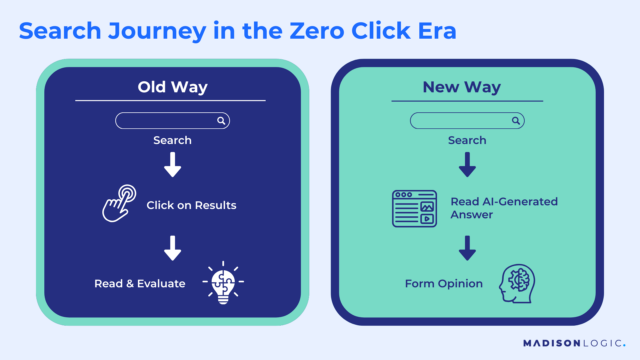
This means discoverability and perception now happen earlier in the journey—often before anyone ever visits your site. Instead of optimizing exclusively for a destination (your website), SEO now has to optimize for exposure wherever information is consumed.
Why You Need to Optimize for Both Technical and Content Performance
In the zero-click era, SEO success is no longer determined solely by what you publish, but by how easily platforms can interpret, extract, and reuse your information.
Search engines and AI systems don’t read content the way humans do—they rely on structure, signals, and patterns to understand what a page is about, how it connects to other content, and whether it should be trusted. Without strong technical foundations, even your best ideas may never surface in AI summaries, featured snippets, or rich results.
At the same time, technical optimization alone isn’t enough. Once content is discoverable, it must be clear, specific, and easy to summarize. AI prioritizes content that delivers direct answers, uses straightforward language, and is structured for extraction. Vague or overly complex messaging is more likely to be ignored—or worse, misrepresented—when platforms generate summaries or responses.
Technical optimization determines whether your content is visible. Content optimization determines whether it’s usable.
One governs discoverability; the other governs interpretation. And in modern search and AI systems, those two forces shape not just if your content appears, but how it’s represented, summarized, and reused wherever discovery now happens.
How to Approach Technical Optimization in a Zero-Click World
Technical optimization is about making your content easy for AI and search engines to understand, connect, and trust. In a zero-click environment, clarity matters more than depth. AI systems are not looking for the longest explanation—they’re looking for the clearest one.
Structure Content for Scanning
AI prioritizes clarity over length. The easier your content is to scan, the easier it is for search engines and language models to understand and reuse it. Clear structure helps machines identify what your content covers, how sections relate, and where authority lives across your site.
Strong structure also reduces ambiguity, making it easier for AI to extract summaries, quotes, and answers accurately.
Example: Structuring a Zero-Click Search Explainer
A blog post titled “What Is Zero-Click Search?” might be structured as follows:
- H1 (Page title): What Is Zero-Click Search?
- H2s (Primary sections):
- Definition
- Why It Matters
- Examples
- How Marketers Should Adapt
- H3s (Subsections):
- Use clear, descriptive language
- Reinforce the parent section’s topic
- Avoid clever or ambiguous phrasing
Within each section:
- Open with a short paragraph summarizing the section’s purpose
- Use bullet points where possible to highlight key ideas
- Focus on clarity and relevance over keyword density
Not every section needs subsections. When a concept is simple, a concise paragraph or bullet list is often more effective than added hierarchy.
But structure alone isn’t enough. Schema and internal links provide the context AI systems need to interpret your content correctly.
- Schema markup identifies the page type (for example, an explainer or educational article), helping search engines understand what the content is and how it should be treated.
- Internal links connect the article to related topics like SEO, AI search, and content strategy, signaling topical depth and authority.
- Consistent anchor text reinforces meaning across your site, helping crawlers understand what you’re targeting and how pages relate.
Together, these signals help AI systems move beyond individual pages to understand the broader themes and expertise your site represents—making your content easier to surface, summarize, and reuse across search and AI-driven experiences.
Why It Works: AI can quickly identify the purpose of each section and extract a clean definition or summary without guessing.
Build Topic Clusters
Next, focus on building topic clusters. Topic authority matters more than individual keywords, so rather than creating isolated articles, think in terms of themes and authority. A hub-and-spoke model—where a central, comprehensive page is supported by related subtopics—helps AI recognize what your brand consistently speaks to and understands. Beginner guides and high-level overviews are especially valuable here, because they align with early-stage questions and are more likely to be cited in summaries and AI-generated responses.
An example of this would be a central hub page called “The Complete Guide to Zero-Click Marketing” that links out to supporting articles like:
- Zero-Click SEO Best Practices
- How AI Overviews Work
- Zero-Click Metrics That Matter
- Content Syndication in a Zero-Click World
Each supporting page links back to the hub and to each other where relevant.
Why It Works: This structure signals to AI that your brand has depth and authority on the topic, increasing the likelihood your content is cited in early-stage discovery moments.
Index Your Site
Finally, make your site easy to index and reference. Many zero-click searches are phrased as requests for comparisons, lists, or validations, such as “top solutions,” “pricing comparisons,” or “best options for a specific use case.” Large language models look for clear primary sources, third-party validation from review sites like G2, case studies, and concrete details like pricing, scope, or benchmarks to answer these. The more explicit and accessible this information is on your site, the more reliably AI can surface it—whether directly from you or alongside credible third-party mentions that reinforce your expertise.
One way to do this is with a solutions page that clearly lists pricing ranges, use cases, supported regions, and customer results. Another way is with a comparison blog post that explicitly outlines how your offering differs from competitors, supported by customer quotes and third-party reviews.
Why It Works: When a user asks AI to “compare top ABM platforms” or “list vendors with global CTV capabilities,” the model can reliably extract factual information instead of inferring or omitting details.
How to Optimize Content for AI-Driven Discoverability
Once your content is technically discoverable, content optimization determines whether it’s reused, cited, and trusted. Because AI doesn’t simply link to sources but extracts and recombines information to form answers, your content must be clear, credible, and able to stand on its own. Strong structure, precise language, and explicit takeaways help ensure your message surfaces accurately in AI summaries, featured snippets, and knowledge panels—rather than being diluted or misrepresented.
Write for Real Queries
In the zero-click era, this starts with writing for real queries—not keywords in isolation, but the actual questions people ask. Content built around full questions, FAQs, and glossary-style definitions aligns naturally with formats like People Also Ask, featured snippets, and knowledge panels, giving AI clean language to reuse when generating answers.
Instead of publishing a broad, opinion-based article titled “The Benefits of Zero-Click Marketing,” create a page that mirrors how buyers actually search by structuring the content around specific questions such as:
- What is zero-click search?
- Why are clicks declining in search?
- How does zero-click impact B2B marketers?
Each question is answered in a short, self-contained section that can stand alone if pulled into a snippet or AI summary.
Why It Works: AI and search platforms are designed to answer explicit questions. These formats align with how AI and search platforms surface answers in featured snippets and People Also Ask results.
Keep Data Fresh
Keeping content up to date is equally important. AI systems heavily favor recent information, typically prioritizing data and insights from the last two years. Updating statistics, refreshing examples, and incorporating recent third-party mentions strengthens authority signals and improves visibility across platforms that don’t rely solely on your website as a source.
For example, treat annual trends articles as a living resource rather than one-time posts by replacing outdated statistics with new survey data, refreshing charts, and swapping outdated examples with new ones every six months. Additionally, a visible “Last Updated” timestamp at the top signals recency to both readers and search engines.
Why it works: AI prioritizes recent, validated information, making updated content more likely to surface in summaries and overviews.
Prioritize Clarity
Clarity is what ultimately makes content usable. Straightforward, skimmable language performs best, especially when paired with structured formats like listicles, roundups, and summaries. An “Explain It Like I’m Five” mindset helps ensure your ideas are accessible without oversimplifying your expertise. Just as important, your language should reflect a real understanding of your buyers—their challenges, priorities, and decision-making context—so content resonates with both humans and AI systems trained to recognize relevance.
Here, a complex concept like intent data should be introduced with a simple analogy that explains what it is and why it matters, followed by a short, numbered list that breaks the process into clear steps. The section ends with a brief summary that reinforces the key takeaway in plain language.
Why It Works: The content becomes easy to skim, easy to summarize, and easy for AI to reuse accurately.
Personalize to Real Buyer Needs
Personalization adds another layer of impact. Intent data can reveal what specific accounts care about, how different roles ask questions, and which topics signal readiness to buy. Tailoring your content to those behaviors makes it more precise, more useful, and more likely to surface in high-value discovery moments.
Rather than publishing a single, broad guide, create separate, tailored versions for your different buyer personas that each address role-specific questions, priorities, and success metrics based on insights revealed through intent data.
Why it works: Specificity increases relevance, which both buyers and AI systems reward.
Building Authority and Engagement Without Clicks
Ultimately, the goal isn’t just to attract attention—it’s to retain it, earn trust, and guide engagement. In a zero-click world, every piece of content is more than a page—it’s a signal that informs AI systems, shapes buyer perceptions, and reinforces your authority across the journey. When technical and content strategies work together, your message travels further, influencing buyers even before they click, and ensuring that clicks translate into meaningful engagement. The brands that thrive in this new era are those that optimize for discovery and impact, turning early visibility into long-term relationships and measurable results.
Want to see these strategies in action? Watch the on-demand recording of our webinar, The Attention Shift: Why Distribution Beats Discovery in the Zero-Click Era, to learn how to leverage SEO, content syndication, and public relations to overcome the zero-click shift by making our brand more visible and discoverable.

