
New: Connect HubSpot Smart CRM to unlock Pipeline Insights and understand what drives account progression. Find out more.
New: Connect HubSpot Smart CRM to unlock Pipeline Insights and understand what drives account progression. Find out more.


For decades, marketers have treated the marketing qualified lead (MQL) as the clearest signal of account interest. A prospect downloads a white paper. Registers for a webinar. Requests a demo. Their lead score crosses a threshold, they’re passed to sales, and the opportunity moves forward.
That model worked when B2B buying decisions were driven by a handful of individuals, yet today’s buying reality looks very different.
Enterprise purchases now involve buying groups made up of people across the organization—and often outside of it—who each bring different priorities, questions, and influence to the decision. An engaged lead may indicate that someone is interested, but it no longer tells you whether the account is ready to buy.
An MQL is still a valuable signal. It’s just no longer enough to measure buying readiness on its own.
That was the central theme of our recent webinar, The Buying Group Paradox: Why More Stakeholders Means Fewer Deals—and What to Do About It, where guest speaker Nora Conklin, Principal Analyst at Forrester, and Madison Logic Growth Strategist Jon Tilden explored why marketers need to evolve beyond lead-centric qualification without abandoning the MQL altogether.
Modern marketing teams target accounts but still measure individual leads. That mismatch makes it difficult to understand buying momentum—or prove marketing’s impact on revenue.
Here’s the disconnect: most B2B teams already know they need to market to accounts, not just individuals. Marketing builds campaigns around target accounts. Sales prioritizes those same accounts. But when it’s time to measure success, many teams still rely on individual lead activity.
That approach made sense when a single person could discover your product, become an MQL, and move through the buying process on their own. But that’s no longer how enterprise purchases happen. As buying decisions are made by groups of people, individual engagement alone doesn’t tell you whether an account is moving toward a decision.
That’s where traditional reporting starts to fall short. It tells you who converted, how many MQLs you generated, and which campaigns drove engagement. What it doesn’t tell you is the question that matters most: is the buying group gaining momentum?
As Jon Tilden explains, “That dichotomy between thinking in terms of target accounts while reporting at the lead level is a huge misalignment that has some huge ramifications for how account-based marketing programs can succeed.”
When you’re only measuring individual activity, you’re only seeing part of the story. You miss the stakeholders researching behind the scenes, the people shaping the decision, and the signals that show whether an opportunity is actually moving forward. That makes it harder to understand buying momentum, prioritize the right accounts, and demonstrate marketing’s contribution to pipeline.
Buying readiness isn’t defined by one engaged buyer anymore. It’s defined by whether a buying group is moving toward a shared decision.
Engagement and buying intent aren’t the same thing. One person downloading a white paper or attending a webinar tells you they’re interested. It doesn’t tell you whether the people who will evaluate, approve, and ultimately sign off on the purchase are engaged too.
That’s the reality marketers are working in today. Forrester research shows that the average B2B purchase now involves 13 internal buyers and nine external stakeholders. Those 22 people won’t all engage in the same way or at the same time, but together they influence whether a deal moves forward.
This is where the traditional MQL model starts to break down. It was designed to identify interested individuals, not measure how buying decisions develop across an account. Looking at one lead in isolation makes it easy to mistake individual interest for organizational momentum.
Marketers need to ask bigger questions beyond “Who converted?”: Which stakeholders are engaged? Are the right voices participating in the evaluation? Is interest spreading across the buying group, or is it limited to a single champion?
Those questions provide a much clearer picture of buying readiness because they measure whether a group is building alignment—not just whether one person raised their hand.
The goal isn’t to replace the MQL. It’s to stop treating it as the primary measure of buying intent.
Conklin calls this “MQL plus” or an opportunity-centric approach. The idea is simple: instead of treating each MQL as a standalone success, you aggregate signals across the entire buying group to identify collective buying momentum.
When you shift to an opportunity-centric model, you’re asking different questions:
These questions provide a clearer picture of whether an account is truly ready to buy, and help you uncover opportunities that an MQL-only model would miss entirely.
Buying readiness isn’t defined by how many people engage. It’s defined by who engages—and whether the right mix of stakeholders is moving toward consensus.
Not all buying group members are created equally. They have different roles, different motivations, and different levels of influence. Forrester identifies five key archetypes:
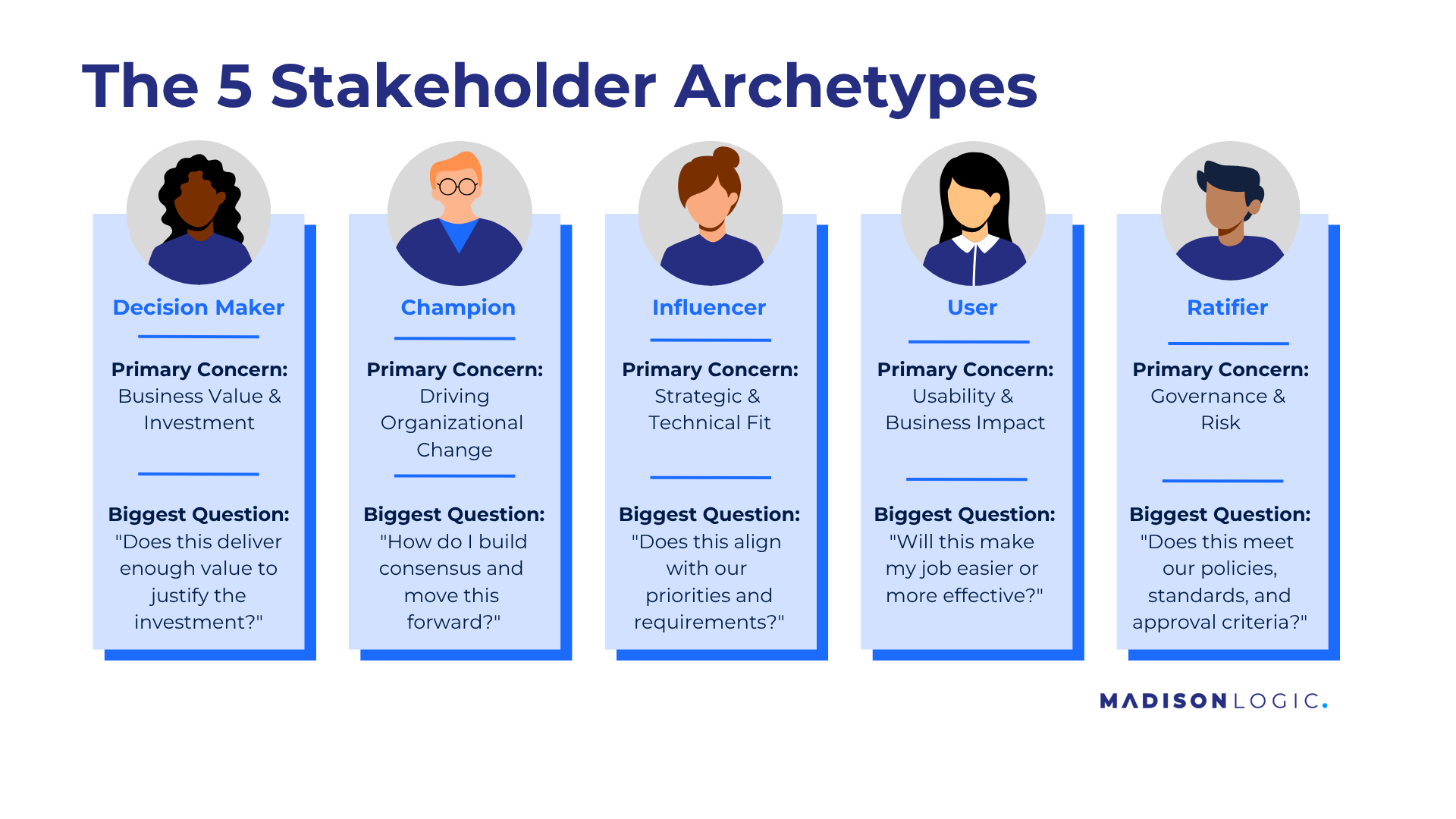
Each archetype enters at different stages of the buying journey, engages at different times, and cares about different things. The user wants proof that your solution will make their life easier, while the decision-maker wants ROI projections, and the ratifier wants to know if your solution is compliant and low-risk.
If you’re only tracking MQLs, you’re likely over-indexing on one or two of these roles and missing the others entirely.
And here’s the kicker: almost half of buying group members aren’t even sitting within the account that’s making the purchase. These external influencers—including analysts, consultants, peer communities, customer advocates, and increasingly AI-powered research experiences—also shape how buying groups evaluate solutions before sellers ever become involved.
You can’t afford to ignore that network. It’s shaping the decision whether you’re aware of it or not.
You don’t need to rebuild your demand generation engine overnight. The goal isn’t to replace your MQL process—it’s to add more context around the signals you’re already collecting.
Think of an MQL as the start of the story, not the whole story. Instead of treating every MQL as an isolated success, begin connecting those individual signals across an account to understand whether the broader buying group is gaining momentum.
For many teams, that’s where the hesitation starts. It can sound like a major operational change: new systems, new processes, and a completely different way of measuring marketing performance.
Throughout the webinar, both speakers emphasized that the opportunity isn’t to rethink everything overnight—it’s to start connecting the signals you’re already collecting.
Here are three practical steps to get started:
Start by defining your key buying archetypes and assigning role-based engagement weights to their activities.
As Jon Tilden put it during the webinar, many organizations are still operating with “MQL islands”—individual engagement signals that never get connected into a bigger picture.
Not every interaction tells you the same thing. Not every interaction carries the same weight. A champion downloading a case study, a user visiting your pricing page, and a decision-maker attending a live demo all tell you something different about where the buying group may be in its evaluation.
Weighting engagement by both role and intent helps connect what would otherwise look like isolated MQLs. Instead of evaluating individual actions, you begin to see how engagement is building across the account.
Once you’re connecting those signals, the next step is turning them into an account-level view of buying readiness.
Instead of waiting for one person to hit a lead score threshold, look for patterns of engagement across the buying group. When a champion, an influencer, and a decision-maker all become active within a short period, that’s a much stronger indicator of momentum than any single MQL.
As your view of buying intent evolves, your reporting should evolve with it.
Instead of focusing on MQL volume alone, start tracking metrics that reflect account progression and revenue impact, such as:
These metrics help marketing and sales evaluate success through the same lens: how effectively marketing contributes to pipeline and revenue—not just lead volume.
Marketing teams that continue optimizing for individual leads will struggle to explain pipeline in a buying-group world. Teams that measure collective engagement will identify opportunities earlier, align more closely with sales, and build a more accurate view of buying intent.
The shift from a lead-centric to an opportunity-centric model is an evolution, not a revolution. The organizations that outperform won’t necessarily generate more MQLs—they’ll build a better understanding of the people, relationships, and signals that collectively drive buying decisions.
It’s about removing the blinders of an MQL-only view and seeing the full picture of how deals are really won. It’s about aligning your measurement strategy with the reality of how modern B2B buyers make decisions—collaboratively, across departments, with input from a network of internal and external voices.
The marketers who make this shift will be able to uncover opportunities their competitors are missing. They’ll shorten deal cycles by engaging the right stakeholders at the right time and build stronger alignment with sales because they’re finally speaking the same language.
The question isn’t whether buying groups are complex. We know they are. The real question is whether you’re going to keep measuring success like they’re not.
The shift from a lead-centric to an opportunity-centric model is a journey. View the on-demand recording of our webinar to see what we’ve discussed here in action. And when you’re ready to see the full picture, request a demo with the Madison Logic team to build a framework tailored to your business goals.
See how Madison Logic helps enterprise marketers convert their best accounts faster.

