


Expectations around marketing’s ability to demonstrate direct business impact are rising. According to Madison Logic’s 2026 Performance Marketing Survey, 63% of organizations now evaluate marketing based on pipeline generated or influenced, and 76% report increased expectations around demonstrating measurable business impact. Nearly half (41%) say those expectations have increased significantly.
Despite this shift toward revenue accountability, many organizations still struggle to connect marketing activity to pipeline outcomes with any confidence. Engagement metrics look strong. Campaigns perform. Leads flow in. But pipeline? That’s where the story gets murky.
The common instinct is to treat this as a campaign problem, whether that be an attribution gap, a channel performance issue, or a reporting limitation. But the data tells a different story. In many cases, the real problem isn’t marketing execution at all but instead a visibility problem. More specifically, the breakdown in shared visibility that happens when sales and marketing operate in separate worlds.
When that visibility disappears, performance becomes nearly impossible to measure, optimize, or prove.
Why Sales and Marketing Misalignment Has Become a Performance Marketing Problem
The definition of marketing’s job has fundamentally changed. Not long ago, marketing was primarily measured on lead volume—how many marketing qualified leads (MQLs) it generated, how efficiently it filled the top of the funnel. Alignment with sales was a nice-to-have that improved lead handoff efficiency. Today, that standard no longer holds.
As organizations shift from activity-based metrics to pipeline and revenue accountability, marketing can no longer hand off a lead and consider its job done. Marketing is now responsible for outcomes it can only achieve with sales, not independently of it.
That’s the critical shift: when marketing was responsible for leads, alignment improved efficiency. When marketing became accountable for pipeline, alignment became necessary for measurement itself.
The result is a new performance marketing reality. Success can no longer be proven by campaign outputs alone. It requires visibility across the entire revenue journey—from first engagement through closed-won—and that kind of visibility doesn’t exist when sales and marketing operate from disconnected systems with incompatible definitions of success.

Misalignment Creates a Pipeline Visibility Gap
At the heart of most performance measurement problems is a visibility gap—a point in the funnel where marketing’s line of sight simply goes dark.
Marketers generally maintain strong confidence in measuring early-stage activity. Our research shows that 85% of marketers say they are confident measuring engagement, and 85% are confident measuring leads. Confidence in measuring MQLs sits at 71%. Those numbers look healthy.
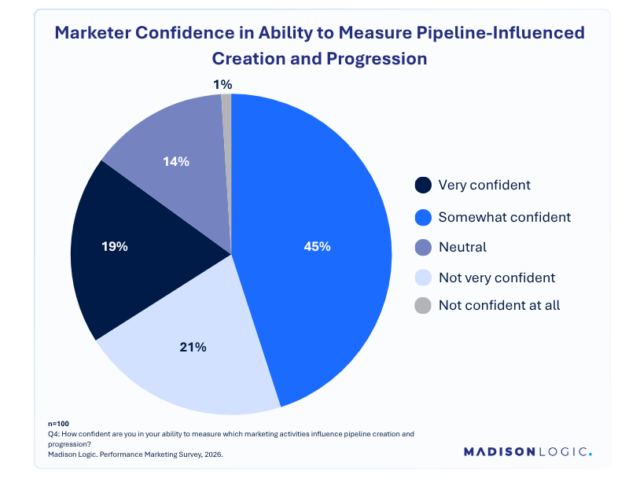
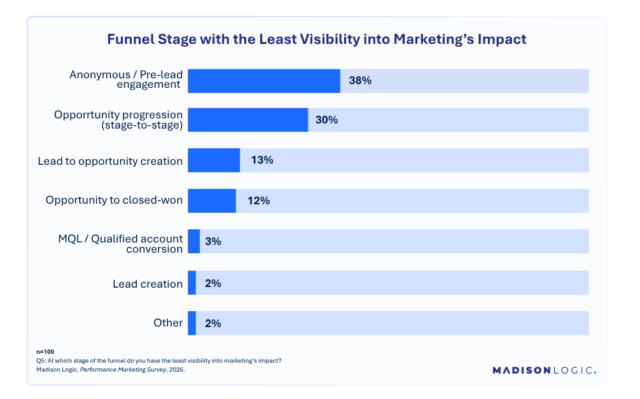
But follow the journey further into the funnel and confidence craters. Only 53% of marketers report confidence in measuring pipeline influence. That confidence drops even further when evaluating pipeline velocity, where just 34% say they can effectively measure progress through the funnel. Meanwhile, 30% acknowledge they lack sufficient visibility into opportunity progression altogether.
This isn’t a data quality problem; it’s a structural one. When sales and marketing operate from disconnected CRM and marketing automation systems, with inconsistent handoff processes and no shared reporting infrastructure, visibility doesn’t gradually fade. It falls off a cliff.
The result is a funnel where marketing can see everything it touches and almost nothing that happens afterward. Opportunity stages, deal progression, sales outreach timing, stakeholder engagement within accounts—all of it becomes opaque. And as any performance marketer knows, you cannot optimize what you cannot see.
The Real Cost of Misalignment: Strong Engagement, Weak Pipeline Outcomes
Here’s the assumption that misalignment consistently exploits: if a campaign performs well, pipeline will follow.
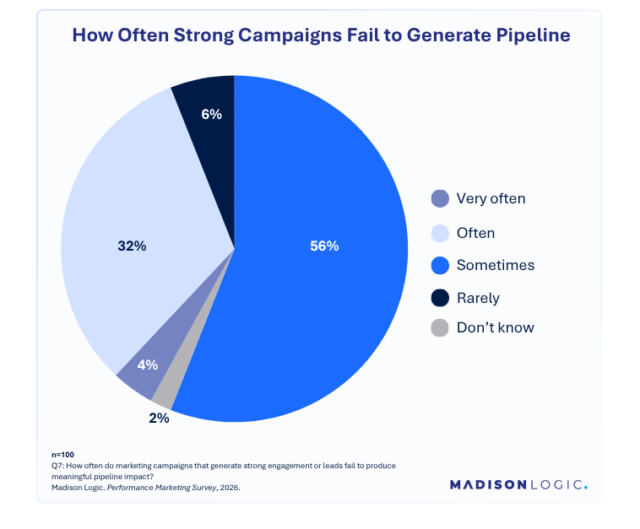
It doesn’t always work that way. Our survey found that 56% of marketers say strong campaigns sometimes fail to generate pipeline, while nearly a third (32%) say this happens often. Four percent say it happens very often.
That’s a staggering disconnect that has real consequences for how organizations diagnose performance problems. When a well-targeted, well-executed campaign fails to move the pipeline needle, the temptation is to revisit creative, reconsider channel mix, or interrogate the audience strategy. But the real breakdown is frequently happening somewhere else entirely.
Delayed sales follow-up. Poor lead prioritization. No continuity between marketing nurture sequences and sales outreach. A complete lack of shared context between what marketing engagement revealed and how sales engaged next. These aren’t campaign failures—they’re process and visibility failures that sit squarely in the gap between marketing and sales.
When those breakdowns go undiagnosed, organizations spend resources optimizing campaigns that aren’t actually the problem. They adjust targeting, revise messaging, shift budgets, yet nothing changes because the issue was never the campaign. It was what happened after the campaign.

Why Revenue Visibility Matters More Than Attribution
When performance measurement breaks down, attribution usually gets the blame. Organizations invest in more sophisticated attribution models, add new tracking parameters, or debate the merits of first-touch versus multi-touch versus data-driven approaches. These conversations have their place, but they’re often a distraction from a more fundamental problem.
Attribution can only be as accurate as the visibility supporting it. No model, however sophisticated, can assign credit for touchpoints it can’t see. And when, according to our research, nearly two-thirds of organizations cite fragmented data as their biggest measurement challenge and 46% report their attribution models lack stage-level visibility—the problem isn’t the model. It’s the underlying data architecture.
The gap typically lives at the intersection of disconnected marketing automation and customer relationship management (CRM) systems where lead records and opportunity records exist in parallel but never fully integrate. Marketing sees engagement and sales sees the deal, but nobody sees the complete picture of how one influenced the other.
This is why pipeline influence—the measurement that matters most in a pipeline-accountable world—lands at only 53% confidence. Marketers aren’t just uncertain about which touchpoint deserves credit; they’re uncertain whether their measurement infrastructure can even detect the connection between engagement and opportunity movement.
Modern Buying Journeys Are Making the Visibility Problem Worse
If sales and marketing misalignment created the visibility gap, modern B2B buying behavior is widening it.
Today’s enterprise purchase rarely involves a single buyer making a linear decision. Buying committees now span multiple stakeholders across functions and seniority levels. Journeys are non-linear with prospects engaging, going dark, and re-engaging months later through a different channel with a different team member. A significant portion of research and evaluation happens in the dark funnel through peer conversations, analyst reports, community discussions, and self-directed content consumption that never registers in any marketing platform.
Traditional measurement approaches built around individual leads progressing through a defined funnel weren’t designed for this reality. When a single deal involves five to 16 people across multiple channels over a months-long journey, disconnected sales and marketing teams simply cannot reconstruct what happened. Each team sees fragments, and neither sees the whole picture.
The more complex buying becomes, the higher the cost of misalignment. Organizations that can’t connect marketing engagement to account-level opportunity progression will consistently undercount marketing’s influence, misattribute pipeline, and make resource allocation decisions based on an incomplete picture of what actually drives revenue.
This is no longer an edge case. It’s the standard operating environment for modern B2B organizations that demands a fundamentally different approach to measurement.
The Future of Performance Marketing Is Shared Pipeline Visibility
The path forward isn’t better attribution models or more marketing dashboards. It’s shared visibility into how opportunities actually move.
The emerging priority for leading performance marketing organizations represents a meaningful shift in philosophy:
- From attribution to progression: Less focus on assigning credit for the lead, more focus on understanding what moved the deal.
- From activity to outcomes: Measuring what happened in the account, not just what marketing sent.
- From lead reporting to pipeline movement: Tracking stage-to-stage progression, opportunity health, and pipeline velocity alongside engagement metrics.
Practically, this means sales and marketing teams operating from shared reporting infrastructure with unified views that connect campaign engagement to CRM opportunity data, so both teams can see how marketing influenced pipeline from initial touchpoint through close.
It also requires measuring multi-channel influence at the account level to understand how different types of engagement correlate with pipeline acceleration or stagnation. Teams need to build alignment not just around shared definitions, but around shared dashboards that give everyone visibility into what’s actually moving.
The fact that our research reveals that only 26% of organizations currently prioritize improved multi-touch attribution—and just 24% prioritize better sales and marketing measurement alignment—suggests most organizations haven’t fully made this shift. But the direction is clear: the question performance marketers are increasingly being asked isn’t “which touchpoint generated the lead?” It’s “what helped move the opportunity forward?”
Answering that question is the next competitive frontier in performance marketing.
Performance Marketing Doesn’t Fail Because of Marketing Alone
It’s easy to treat performance marketing challenges as campaign problems. Adjusting targeting, refreshing creative, and rethinking the attribution model are all interventions that feel productive—and sometimes they help. But our research points to a different diagnosis.
When marketing loses sight of what happens after the handoff, it loses the ability to understand what drives pipeline, where opportunities stall, and how its work connects to business outcomes. Attribution breaks down not because the models are wrong, but because the underlying data is incomplete. Optimization becomes guesswork, and reporting becomes a negotiation rather than a measurement.
As accountability expectations continue to rise, optimizing campaigns in isolation is no longer sufficient. The organizations that will lead performance marketing in the next era won’t just be those with the best campaigns; they’ll be those with the clearest view of how those campaigns move opportunities through the revenue journey.
The future of performance marketing belongs to teams that can see, and therefore improve, what happens between first engagement and closed revenue.
Connect engagement to pipeline movement with Madison Logic’s Pipeline Insights Dashboard and gain visibility into how marketing influences opportunity progression across the funnel. Contact us or request a demo today to learn more.
Ready to run ABM the right way?
See how Madison Logic helps enterprise marketers convert their best accounts faster.

