


In B2B, influence isn’t about visibility—it’s about velocity. It’s the force that accelerates decisions, reduces risk, and shapes how buyers evaluate solutions long before a sales conversation begins.
But influence doesn’t come from a single voice. It’s built through a coordinated system of roles that guide buyers from awareness to advocacy.
The most effective B2B marketers don’t rely on isolated campaigns or individual advocates. They orchestrate four distinct types of influence—each playing a strategic role in shaping perception, validating outcomes, and sustaining engagement across the buyer journey.
When these roles work together, influence becomes more than awareness. It becomes a growth engine.
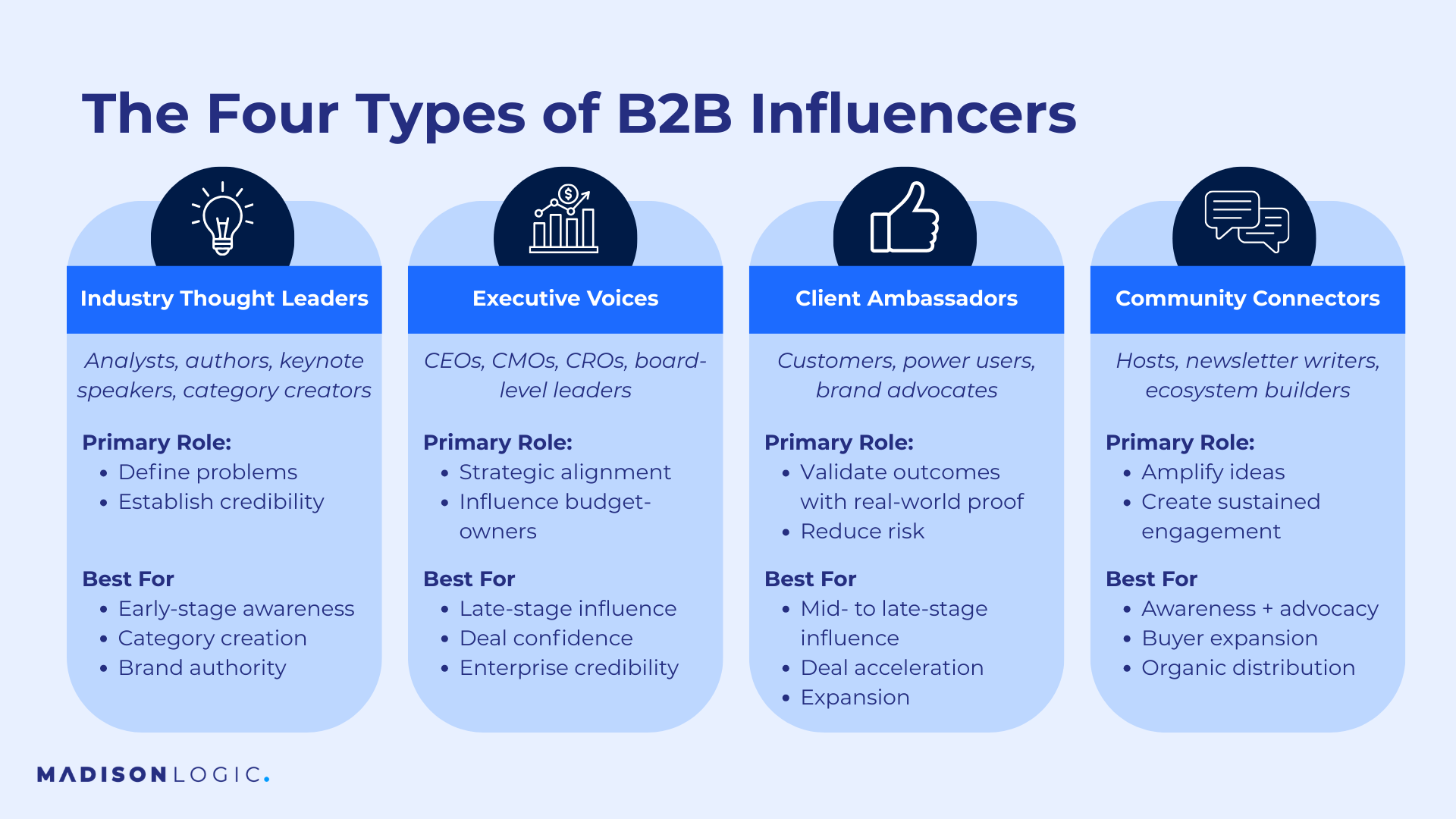
1.Industry Thought Leaders: Shaping the Market Narrative
Think of thought leaders as the architects of perception. They don’t sell products—they frame the problem, define the category, and set the narrative that informs buyer expectations.
Today’s buyers don’t start their journey on your website. They’re learning from analysts, podcasts, LinkedIn voices, AI-generated answers, and peer conversations. By the time they begin researching vendors, they’ve already formed an opinion about what the problem is—and what a good solution should look like.
Thought leaders shape that early understanding. They introduce the language buyers use, the trends they pay attention to, and the criteria they’ll later apply when evaluating providers. If your brand aligns with that framing, you enter the conversation as a credible option. If you don’t, you’re fighting uphill.
This works because influence now happens before intent. Buyers form perspectives long before they ever raise their hand. When thought leaders define the conversation early, they reduce friction later—warming the market before demand is declared.
| Industry Thought Leaders | |
| Who | Analysts, authors, keynote speakers, category creators |
| Primary Role | Define problems and establish credibility |
| Best Used For |
|
2. Executive Voices: Reinforcing Strategic Confidence
In complex B2B deals, buyers aren’t just evaluating a product—they’re evaluating whether your organization can execute. Executive voices play a critical role in signaling alignment, stability, and long-term vision.
Executive influence works best when it’s personal and specific. Generic messaging from leadership doesn’t move the needle. When CEOs, CMOs, or other senior leaders speak publicly about strategy, market trends, or lessons learned, they humanize the brand and reinforce that the company stands behind its commitments. This matters most when buying groups are narrowing their options. At the decision-making stage, perceived risk becomes the primary barrier. Executive visibility reduces that risk by communicating confidence and accountability at the highest level.
This works because people build trust faster than brands do. When buyers hear directly from leadership, it accelerates credibility, supports sales conversations, and gives budget owners greater confidence in moving forward, making deals feel safer to approve.
| Executives | |
| Who | CEOs, CMOs, CROs, board-level leaders |
| Primary Role | Foster strategic alignment and influence budget-owners |
| Best Used For |
|
3. Client Ambassadors: Validating Outcomes with Proof
Even strong thought leadership and executive messaging can leave one question unanswered: “Will this actually work for us?” Client ambassadors answer that question.
Clients, power users, and advocates provide peer-level validation that no brand message can replicate. Case studies, testimonials, and peer references show measurable outcomes, implementation realities, and tangible ROI that transform uncertainty into confidence.
In today’s buying environment—where committees are larger and consensus is harder to reach—social proof becomes a unifying force. Social proof doesn’t just communicate “we like this product.” Instead, it must clearly show measurable outcomes and repeatable success to reduce risk. Client ambassadors accelerate consensus across buying groups by answering the unspoken question every buyer asks: “If we do this, can we really achieve the results?”
The most powerful client ambassador programs don’t just highlight successes—they create ongoing dialogues where prospects can see challenges overcome in real time. Peer validation helps align stakeholders with different priorities because it shifts the conversation from promises to demonstrated results. This works because social proof removes doubt. Buyers trust people who’ve already taken the leap. When real customers validate outcomes, they reduce risk, accelerate decisions, and support expansion conversations.
| Client Ambassadors | |
| Who | Customers, power users, brand advocates |
| Primary Role | Reduce risk and validate outcomes with real-world proof |
| Best Used For |
|
4. Community Connectors: Sustaining Influence Over Time
Influence isn’t a one-time campaign. It’s an ongoing presence. Community connectors—hosts, moderators, ecosystem builders, and trusted voices within professional networks—maintain engagement between buying cycles. They create spaces where buyers ask questions, compare notes, and validate decisions with peers.
These conversations often happen outside your visibility in “dark social” spaces like emails, Slack, Microsoft Teams, and LinkedIn messages. Buyers crowdsource opinions long before reaching out to sales. Community connectors help shape those conversations and keep your brand relevant even when no active deal is in motion. This works because trust compounds over time. When your brand consistently appears in credible peer environments, it builds familiarity and equity that carries into future buying moments versus having to start off cold. Influence becomes always-on rather than episodic.
| Community Connectors | |
| Who | Hosts, newsletter writers, ecosystem builders |
| Primary Role | Amplify ideas and create sustained engagement |
| Best Used For |
|
Orchestrating Influence as a Growth System
The most effective B2B influencer marketing strategies don’t pick a single type of influencer—they orchestrate all four.
- Thought leaders create awareness and context.
- Executive voices establish trust and confidence.
- Client ambassadors validate outcomes and reduce risk.
- Community connectors sustain engagement and amplify ideas.
When these roles work in concert, influence stops being a series of disconnected campaigns and becomes a self-reinforcing growth engine. Every interaction builds credibility, accelerates decisions, and nurtures long-term relationships.
In B2B influencer marketing, it isn’t about who shouts the loudest; it’s about reaching the buying group roles who shape the decisions that matter, in the right sequence, at the right time. And when orchestrated thoughtfully, it doesn’t just move deals—it moves markets.
See B2B Influence in Action
Understanding the four types of B2B influencers is just the start; knowing how to orchestrate them across your buyer journey is where real growth happens. When thought leaders, executive voices, client ambassadors, and community connectors work together, influence becomes a system that drives trust, reduces risk, and sustains momentum.
Want to learn how to operationalize influencer-led strategies that drive credibility, relevance, and measurable impact? Watch our on-demand webinar, “The Trust Shift: How Influence, Identity, and Communities Are Reshaping B2B Growth” to learn how leading B2B marketers are building influencer programs that generate measurable results.

